Thursday, January 24, 2008

Jan 24th: A Day To Remember

It was the best of times.
It was the worst of times.
We racked Petite Verdot wine into a new French barrel, finishing the task before midnight, but Bluey was lame and could only look, hopping along on 3-paws.
Today is our 20th wedding anniversary;
We have been married for 20 years.
It's raining.
A rainbow opened up at our doorstep.
Perhaps this marriage is blessed.
And it appears Bluey is healing.

Time to go out and bang some stakes in the ground while the earth is moist.

Monday, January 7, 2008

New Year: New Vineyard

The New Year is underway and so is our work installing a new trellis system, Phase II of the Blue-Merle Vineyard Master Plan. What better time to catalog this work step-by-step for those of you considering planting your own vineyard this year. We've decided to increase our plantings of Grenache, Aglianico and Petite Sirah, and to fill in some significant gaps in the vineyard landscape. We will be planting an additional 190 vines, bringing out total to well over 1,000 vines. Many of our rows are wide (16 ft.) -- which means we could increase the density of our plantings. But let's face it. This is supposed to be a hobby, not a profession. This will be enough. At least until next year.

Here's a check list for those of you wanting to get started. Like most things in life, there are more than 100 ways to skin this cat. So don't take my words as a must-do manual; this is what worked for us. (Be sure and share with us what worked for you!)

Develop a master landscape plan for your property.

Design your vineyard, either making a sketch by hand, or using a computer program such as SmartDraw. Remember, "vineyard is art." Keep this motto in mind as you design and install the vineyard. Follow the contour of the land. (At first, I had a notion that rows were supposed to be North - South. That would have been a mistake on our hillside, so we followed the land.) Read books on the topic, such as Vineyard Simple and from Vines to Wine.

Consult with a local vineyard expert as necessary and as desired. Decide how much of the work you want to do yourself, and how much assistance you require. In the San Diego area, there are consultants who will implement your vision for you. The going rate is approximately $40/vine, including the trellis system, irrigation, vines and planting. (Of course the final cost will depend on terrain -- and how many unexpected obstacles confront you -- such as a humongous 3,000 lbs. rock directly under a spot where you want to dig a post hole!) Another good reason for consulting with an expert is you may need help down the road maintaining the vineyard (mildew control, Pierce's Disease prevention, etc. -- hey, I never said this was going to be easy, but, you can do it.)

Prepare your land. Are you able to plow or till your land? Do you need to add any nutrients? (As we are on a steep hillside, there was little we could do in this regard.)

Stake out your vineyard design, using stakes, string and measuring tape. The string really helps you visualize the location of rows, and the spacing. (Also use the string to line up your end posts when you get to that step).

Ready to get started? If you're ready, and you'll be hiring labor, you'll save yourself a bunch of money by having everything staged and organized in advance. So plan, and have everything ready:

Dig your post holes. For digging, your choices are by hand with a post digger, with a handheld auger (which rent for about $50/day at Home Depot) or the auger of a professional drill (such as that provided by a BobCat). Note: You would be smart to start digging at the "cornerstone" to set the first post. Then, go to the end of your planned rows, and set that post. With those two posts set, use string to define the line by which to perfectly line up your other posts. As you will be looking at your vineyard everyday, the time spent in lining up your rows correctly is well worth it! We used 10 ft. poles when we installed over 30 rows last year. This year we purchased some smaller 8ft poles for some of the short rows we're installing. Believe me, the 8ft poles are a lot easier to work with and to carry around! (Discuss with your consultant what poles are appropriate for you.) The depth of your holes will depend on your poles and your digging method. When we used the BobCat auger, we went about 4 ft. deep. When digging by hand, we try to go at least 3 ft. At a minimum, we went 2.5 deep in some places. Remember to angle the hole, so the post will be at an angle (and be able to accommodate more weight and tension when the wires are tightened).

Set the posts. There are a number of different ways to do this. One is to insert the post, then maybe add back some dirt, compacting it (with a "compactor"). Use a level, to make sure the post is "straight." If you "eyeball" it, I guarantee you will be redoing some posts. Once "level" (straight) add cement. I prefer to mix the cement in a wheel barrow -- then add it. We found that 2 @ 60 lbs. bags for each post was right for us. Others might only use one bag and refill the rest of the hole with dirt then compact it. Another technique would be to pour dry cement down the hole, then add water, and stir (but like I said, I prefer whenever possible to do the mixing first in the wheelbarrow, then pour). After setting the post, you may make a "brace" to keep it in place. After the concrete is dry, the post should be extremely stiff, and not budge when you push it at all. (When setting a few posts over the Christmas holiday, I tried to take a short cut and see if I could get away with a hole 2 ft. deep and one bag of concrete. This was a total failure, and we had to redo those three posts the next day.)

7) Align the posts. Use string.

This is a good place to take a rest. In the next post, we'll talk about irrigation, installing the drip system, and stringing and tightening the wire. Click here if you want to see highlights how we installed the vineyard at the Blue Merle last year.

(February 28, 2008) -- The trellis system is in. The drip lines are in. We've got gophers and weeds to deal with. We'll use an auger to start digging the holes this weekend. Nova Vines is shipping the vines out next week. We'll plant those babies in 9 more days. We were able to up the shipment to 235 vines, including an extra 25 Tempranillo, bringing the total to 1,085. We also finished pruning the first year vines. More about that later. The gophers are attacking. Need to get an owl. Just warmed up this week; the snakes must be thawing out, so need to keep an eye on them. Bluey's paw getting better -- seems to be non cancerous. He must have pricked it on a bougainvillea while digging.

Monday, December 31, 2007

New Year's Preparations

New Year's Eve, 2007 -- It's been another 3-ring circus at the little vineyard on the hillside in Blue-Merle Country. In the first ring was the setting of 10 ft. posts and stringing wire for drip lines and cordons for new vines to be planted in March. The second ring was construction of the Great Wall of Merle -- a 120-foot retaining wall. On top of that, preparations were under way in the household below for welcoming in the New Year -- was it really Christmas a week ago -- not to mention feeding a crew of workers. The Ringmaster barking orders was having a grand old time. I couldn't help but sing this song as we dug 4-ft holes, hauled boulders, and carried 500 cinder blocks down the mountain:


"On the 12th day of Christmas my true love gave to me:

12 lines of vines
11 hundred lbs. mortar
10 rebar bundles
9 tons of stone
8 fresh oranges
7 pallets of block
6 bottles Chateau Lafitte
5 circling hawks
4 guys working
3 hanging gophers
2 yucca plants
and a talking Aussie Shepard."

Tuesday, December 25, 2007

Christmas At The Blue-Merle Winery


Welcome, warm, Santa Ana winds gusted through the rows of vines in Blue-Merle Country as the orange glow behind the eastern mountains signaled daybreak's advance, bringing paradise weather to a land in winter. Christmas Morning; Red Flag Warning. Unlike those frightful days of October when those devil winds ushered in acrid, ocher smoke, today they are an enjoyable gift.

As the 20th anniversary of our marriage approaches, the Queen has left several hints for the present she desires. Not just a diamond. Twenty diamonds, one for each year she has endured with me (and boy does she deserve them). I have hid the big "rock" in her stocking. Twenty tons of rocks. Merry Christmas, darling.

If there were a poll about what profession Jesus might choose for a next appearance, I would vote for mason. Laying the cornerstone; laying the bricks. What a noble line of work. Building things. This is how we are spending our Christmas. Laying the foundation for retaining walls, holding back the earth with rocks. It is body numbing work, giving the mind a chance to wander, reflect and to say prayers for all of those we care about. Vineyard is art. Vineyard is meditation. Vineyard is prayer.

Attentive readers will ask, "Where is the Princess?" She has gone Indian, with a decorative nose piercing. She was in Bollywood last week, New Delhi today, the Taj Mahal tomorrow and a pilgrimage to the Ganges next week. When she returns in January, there will still be plenty of paths to be dug, and rocks to be placed.

John & Gunvor brought a special gift -- 6 bottles of Chateau Lafitte Rothschild! Of course, they are all vinegar, John says, as they are from the 1970 vintage, and have been cellared in California homes all of these years. Well, if my Queen wishes for diamonds, I wish for one of the bottles to be unspoiled. We will share the spoils at a hastily called meeting of the Hidden Meadows Winemakers Association . Merry Christmas!

Sunday, December 23, 2007

Winter Solstice At The Blue-Merle

December 23, 2007 -- Full moon rising over the Blue-Merle Winery at the time of the Winter Solstice. At precisley 5pm, the moon has entered the wine glass on the table of the terrace, as seen by a crowd of spectators who have come to witness the event. The flash of cameras; the push of digital video recorder buttons; the barking dog (and howling coyotes) to capture the moment for the world. Webcast: Live from the Blue-Merle.
Scene Two: A few moments later, from inside the winery, looking through a glass window, the full moon to the Northwest; a reflection, the glow of the setting sun to the West, highlighting Catalina Island, and the Pacific Ocean, seen side-by-side, in the window pane, a surreal picture-in-picture, observers sipping a glass of wine, previously shined on at 5pm by the full-moon.

(The Blue-Merle Winery is now taking reservations to attend the Summer Solstice celebrations and the 2008 Winter Solisitice. All are welcome.)

P.S. (December 24th) -- As we celebrated the return of longer days, our neighbor Pam marked the passing of the seasons with the death of her father. She sent us this note and poem:

"Dear friends, Just a short note to let you know that my father died today at Yavapai Regional Medical Center. My sister, her husband, my brother, Paul and I were at his bedside. I've attached a poem I just wrote. Thank you for your prayers. with love, Pam


My father passed away
This first day of winter
As if unwilling to spend
Another cold season
Bedridden,
Too lonely
Without his life’s companion
By his side
This first day of winter
Early morning
We said goodbye and
Turned off the machines
Which kept his breathing going
I held his hand
and watched for his soul to leave
But only caught the shift,
the physical moment
His body turned to stone
This first day of winter’s eve
I spoke of the accident
Said how sorry I was
And asked my father’s forgiveness
For my part, my responsibility
For his year of suffering
His response,
A rapid rise in respiratory rate
Alarms and bells
Ringing
Let me know
He heard my voice,
Perhaps he heard my plea
This first day of winter
It’s cold outside
Inside my body’s like a furnace
Burning with the grief and hurt
Of the loss, of the prospect
Of a world without
My father in my life
A new season
Usually means a new beginning
This first day of winter
It’s cold outside."

Monday, December 10, 2007

Planting The Cover Crop

Last Friday (Dec. 7) we were blessed with another rainy day (that's two Fridays in a row in a drought plagued land) so the plan for the weekend was more digging, terracing and sewing a cover crop. Planting a cover crop on a steep slope is an intersting proposition (some would say "foolish"), especially since I can't get a lawn mower, much less a tractor, up there to cut it once it grows. Planting a cover crop is asking for more work -- how will I find the time to maintain it? And what if the seeds migrate down to the vines? More trouble. On the other hand, having a natural barrier of grasses or flowers will help control erosion and return nutrients back into the ground. So this year, I decided to experiment. I picked a couple of relatively flat areas (which are rare in our vineyard) to give it a try. If it turns out disastrous, I'm only looking at problems in 2 rows out of 40. As the earth was moist from the rains, I was able to combed her easily with the rake, creating a path down the center of the selected rows. I spread some annual grass seed, and covered with hay. Temperatures were in the 40s on Sunday (cool by California standards) with clear views to snow capped mountains to the North and out to Catalina Island in the Pacific to the West -- with very few birds except for circling hawks. (One of my concerns was that this effort would simply result in a feast for crows .) The clay and decomposed granite that make up most of the the Blue-Merle Vineyard drain quickly, and by Sunday evening, the muddy & moist areas that I had raked earlier in the morning had begun to dry. (I was beginning to wonder if I would need to water the seed after all of that rain.) The seed has been set; let's see what takes. (Hopefully, we will not find grass sprouting at the base of the vines -- but an emerald green carpet running straight down the row, accenting the land with the promise of spring to come.)

Gustavo came out and inspected the routes for delivering a 20 ton truck-load of rock, slate, ledger, mortar, rebar and concrete blocks for continuing our work on The Great Wall. He thinks he can maneuver a fork lift onto key areas of the property, and make the drop. His planned date: This Friday. Although we survived the second set of heavy rains without catastrophe, there is erosion, and the retaining walls will be helpful long term. "Vineyard is art" and the retaining walls are the frame.

Will the fork lift get stuck in the mud? Will weeds sprout faster than the cover crop and take over? How will we cut the grass if it starts growing? If we hire the neighbors goats to graze the grass, will they eat the vines instead? Will rains continue next week, eliminating the mandate for growers to cut their irrigation by 30% next year?

January 3rd, 2008 -- update on the cover crop. The seed has taken root and there are paths of green where we sowed. Another winter storm is on the way. Fidel says he wants to spray "roundup" herbicide to kill the weeds that are also beginning to show their green tops -- he'll try to kill everything green that isn't a vine. We've got to keep that sprayer from him. So far so good on the cover crop-- as I have 15 lbs. of grass seed left over, I may sow some more this weekend after the first rain (as the earth has turned rockhard again after three weeks of no rain).

Wine Delivered to Diocese & Marketing 101

We bottled 20 cases of wine over the Thanksgiving holiday and a "tithe" of the wine (10%) was delivered to the Episcopal Diocese of San Diego on Saturday morning. The Reverend Canon Steve Wendfeldt accepted the gift on behalf of The Bishop. Canon "Steve" had time for breakfast , so over eggs Benedict dripping with extra Hollandaise sauce we discussed "Church Marketing 101". What he said applies just as well to promoting a winery, or a business:

Become known in the community:
* Join the local Chamber of Commerce. Get a link from their website.
* Approach local real estate agents/agencies about exchanging links. Give them your cards, flyer, brochure which they can include in their information for new comers.
* Get a listing on the website of your town.
* Take out a Yellow Pages listing -- make your listing stand out (by reversing the image, etc.)
* Flyers: post them up at community service bulletin boards, at shopping centers, wherever appropriate
* Identify members of the press in the community who would have an interest, and issue press releases, often. (For example, at Grace Church in San Marcos, the members got together this month and provided Christmas gifts for every single child in the local Head Start program -- that's worth a press release. Another example would be the education classes sponsored by University California San Marcos which are held at Grace Church each week). Be sure and understand the correct format each media outlet prefers.
* Use the church to hold events, such as concerts, lectures, classes, etc. If you have a good piano and a suitable space, contact all the piano & violin teachers in the area, and let them know they may use the church for free concerts.
* Hold a youth dance for teenagers, from 9pm - 2 am. Charge $1 or a can of food (to be given to the local food bank) as admission.
* Offer a "Friday Morning Out" for mom's -- where mom can take a couple hours off, leaving her kid(s) at church.
* During the Christmas season, on an appointed Saturday, offer to take care of the kid(s), so the parents can go shopping. Make this available as a service to the community -- not just the membership.
* Design ministry opportunities for retired seniors. For example, contact local schools in the area to see if they would welcome church members as tutors to help kids improve their reading skills.
* If you live in a town with a military base with lots of deployments, consider a ministry for young mothers (whose spouse may be deployed). Example, have the retired folks who love to knit offer a gift of a sweater/clothing for newborns....
* Use the kid's Christmas pageant as an opportunity to practice "all are welcome" by giving parts to all children who attend Christmas services -- even those who are attending church for the very first time. Prepare extra costumes for angels and shepards, and invite any newcomers you see at church that day to participate. (Make sure there are adults on hand who can guide the little ones who haven't participated in the rehearsals.) Publicize the open pageant to the community. Parts for everyone. No auditions required.
* For a "Blessing of the Animals" service, partner with the local ASPCA or animal shelter to get the word out about the event. The co-marketing will work well for both organizations, as both groups care about critters.

These are all great ideas, and we should follow them up at the Blue-Merle Vineyard and our little church in the valley, Grace Church San Marcos. What would you suggest?

Saturday, December 1, 2007

Ground Squirrel Trapping

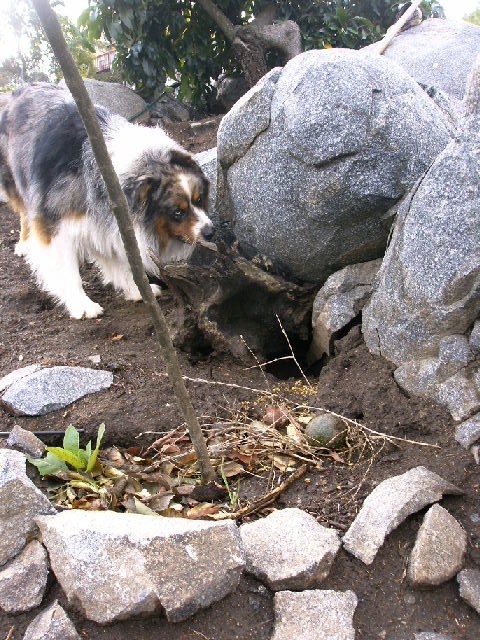
Yet another half-eaten prized "Bacon" avocado lay at the entrance of its home. Adding insult to injury, the squirrel had eaten the avocado we left for him in the trap, leaving behind the nut. He ate it from the outside, without venturing in. This calls for an escalation of techniques: I placed the half-eaten delicacy on the ground, with the trap over it. That way, the rodent will not be able to reach it and pull it to the side; he must go inside to nibble.

(One week later, Dec. 8th)
The avocado meat at the bottom of the cage is gone. Just the skin remains. We're dealing with one, clever fellow here. We gave a bag of lemons to our neighbor the other week, who returned the lemons as a delicious "lemon jam." I will spread that on some toast and see how that works for bait.

(December 23rd, 2007): Public enemy #1 is still at large, with another victim (a stripped avocado nut) by the hole. A new tactic: this guy is located by avocados, and I have taken an orange from another part of the vineyard. I have dog a hole for the orange two inches deep, and placed it in the ground, peeled, with the trap on top, with the peelings making a path from the squirrels home to the center of the trap. Merry Christmas, Mr. Squirrel!

Will we not catch this squirrel before he eats all the remaining avocados? Will we need to call in a terminator to deploy dynamite and flame-throwers? In a weak moment, will we let the squirrel live free, but by doing so, unleash bubonic plague in San Diego County?

Friday, November 30, 2007

Last Watering & First Rain

Two milestones have come to pass. Last Sunday (Thanksgiving weekend, the end of November) was the last watering day with irrigation. The growth for this year is finished. It is time for the vines to rest, to go to sleep, to store nutrition, to save their energy for an explosive burst of growth in the Spring. We will prune in February.

It is raining. Not since we did some grading one year ago at this time, putting in Rue Jean Baptiste ("level the mountain", "make the paths straight") and planting the vines in Spring, has their been a significant rainfall. Tomorrow, I will be a water sleuth, examining what worked and what didn't concerning our drainage plan. Have any vines disappeared in a mudslide? Are all the paths still clear? What new paths need to be dug to move water in a less destructive direction? What mini retaining walls need to be built?
(The next day, Saturday, Dec. 1st.) It rained two inches, and we came through OK. No catastrophes. But there are areas to fix.

I have never seen the hard earth here so malleable. I cut paths into hillsides with a shovel. I molded a shapely berm out of clay. I filled in ditches, and dug min-culverts to better channel the water. As if on cue, the first day of December, the daytime temperature dropped to the 40s with a strong wind as light showers passed. A rainbow appeared.

Thursday, November 29, 2007

Transplanting Vines: Do's & Don'ts

Nick Thompson from the UK has an interesting story about transplanting vines at his property in France. My own experience up to now is two-fold: the first is transplanting cuttings which I had in pots. This worked well, as the vines moved from pot to field (or the fence) and took root as we were able to water them with irrigation during the summer. In the 2nd case, I dug up a first-year vine along the fence from under a large apricot tree where it couldn't get enough sun. I was surprised at how much effort it took to dig up, after being in the ground only a few months. After transplanting to a sunnier spot by the house, it began wilting, and stopped growing upwards. It is still alive, but it has not been happy. My assumption is that it will rest over the winter, get strong, and come back strong in the Spring.
Nick, tell us what happened to you. (These photos accompany Nick's story.)